
The Master Clock: How Syncing with Your Circadian Rhythm Unlocks Peak Health
The overlooked natural remedy hiding in plain sight: aligning daily life with your body’s internal clock.

One of the most powerful natural health practices is also one of the simplest: living in step with your circadian rhythm—the body’s internal 24-hour clock that quietly coordinates sleep, digestion, hormones, mood, immunity, and repair.
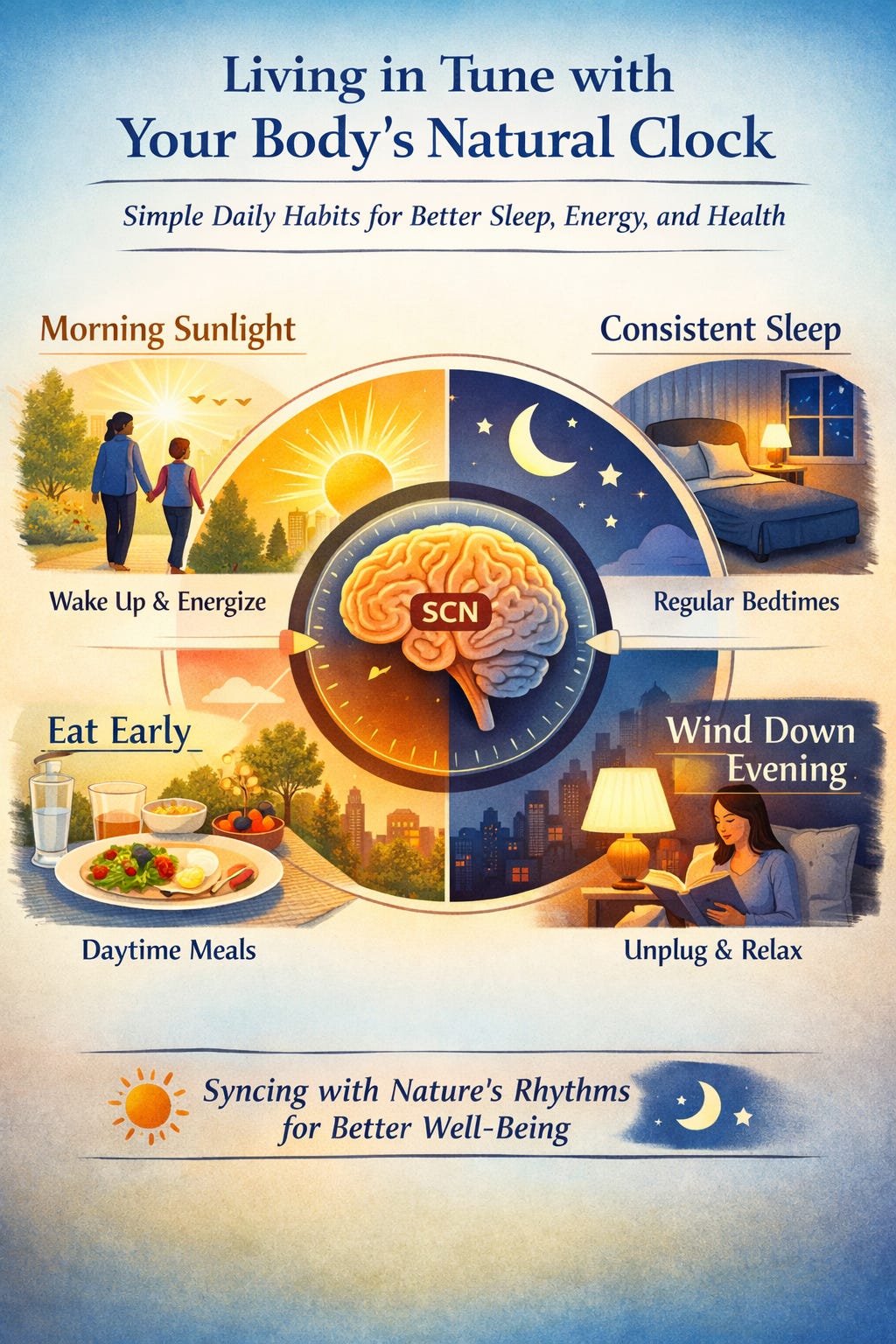
At the center of this system is a small region in the brain, the suprachiasmatic nucleus (SCN), which responds primarily to light and darkness. Morning light signals the body to wake, release energy, and begin metabolic activity. Evening darkness triggers the production of melatonin, preparing the body for rest and nighttime repair.
For most of human history this rhythm followed the natural cycle of sunrise and sunset. Modern life, however especially late-night screens, artificial lighting, irregular schedules, and busy city routines often pushes us out of sync with this internal clock.
Fortunately, restoring circadian balance does not require extreme lifestyle changes. Small daily habits—getting natural light in the morning, keeping regular sleep times, dimming lights at night, and eating earlier in the day—can gradually bring the body back into alignment.
Even in a busy city, and even with family schedules and work demands, these simple adjustments can help the body return to the rhythm it was designed to follow. 🌅
1. Start the Day With Light
Morning light is the strongest signal that sets your body clock for the entire day.
When light reaches your eyes in the morning, the brain stops producing melatonin (the sleep hormone) and begins releasing hormones that promote alertness and energy.
How to implement this in real life
Open the curtains immediately after waking.
If possible, step outside for 10–20 minutes within the first hour of the morning.
Walk the kids to school or the bus stop instead of driving.
Drink your morning coffee or tea by a window or on a balcony.
If you commute early, even a short walk from the train station helps.

Cloudy weather still provides enough natural light to activate the clock. Early morning provides us with the beneficial red light naturally.

For families, turning the morning school run or dog walk into a short outdoor ritual is one of the easiest ways to anchor everyone’s rhythm.
2. Keep Sleep and Wake Times Predictable
The circadian system likes consistency. Going to bed at very different times every night confuses the body’s hormonal signals.
You do not need perfect precision—just a regular window.
How to make this work with busy schedules
Choose a realistic bedtime range (for example between 9:30–10:00 pm).
Wake up at roughly the same time each morning, even on weekends.
If children are involved, anchor the evening routine around their bedtime so the household rhythm naturally settles earlier.
Families often find that when children go to bed earlier and consistently, parents sleep better as well.
3. Use Evenings to Signal “Night”
In nature, sunset gradually reduces light. In cities, bright lighting and screens often trick the brain into thinking it is still daytime.
This delays melatonin production and makes falling asleep harder.
Practical evening adjustments
Dim household lights 1–2 hours before bed.
Switch to lamps instead of overhead lighting if possible.
Reduce screen use before sleep, especially phones held close to the face.
If screens are necessary, lower brightness or enable night-mode settings.
For families, a helpful habit is creating a “quiet hour” in the evening: reading, preparing school bags, light conversation, or calm activities instead of bright screens.

4. Eat During Daylight Hours
Your digestive system also follows a daily rhythm. It processes food most efficiently earlier in the day.
Late-night eating can confuse metabolic signals and disrupt sleep.
Realistic eating patterns
Eat breakfast within a few hours of waking.
Have the largest meal in the middle of the day when possible.
Aim to finish dinner 2–3 hours before bedtime.
For families in cities where dinner is often late, even small adjustments help: eating slightly earlier or keeping late meals lighter and simpler.
Some people also find benefit in time-restricted eating or intermittent fasting, where meals occur within a roughly 10–12 hour window during the day.
5. Move Your Body During the Day
Physical activity helps reinforce circadian signals.
Movement also improves sleep quality and reduces stress hormones.
Easy ways to include movement
Walk or cycle for short errands.
Take short outdoor breaks during work.
Practice Tai Chi (Taijiquan)
Use parks or playgrounds for family walks in the afternoon.
Even 20–30 minutes of walking daily can strengthen circadian rhythms.

Children naturally help here—playing outside, walking home from school, or weekend park visits all reinforce healthy daily timing.
6. Protect the Night
Sleep is when the body repairs tissues, regulates immunity, and clears metabolic waste from the brain.
Protecting nighttime rest is one of the most powerful natural health practices.
Simple nighttime environment tips
Keep the bedroom cool and dark.
Reduce noise where possible.
Avoid stimulating activities right before bed.
Try progressive muscle relaxation (PMR) 👇

If city noise or light is unavoidable, tools like eye masks, blackout curtains, or white noise can make a surprising difference.
A Gentle Reminder
Circadian health is not about perfection. Modern life rarely allows a fully natural rhythm.
But small habits—morning light, consistent sleep, daytime movement, and calmer evenings—can gradually bring the body back into alignment.
Even in the middle of a busy city, the same biological clock that guided humans for thousands of years is still quietly working inside us. The goal is simply to give it the signals it understands best: light, darkness, rhythm, and rest. 🌅
Support This Work 🌿
If you enjoy thoughtful, balanced content like this and want to learn more about restoring balance and releasing stress with simple, low-risk techniques and supportive nutrition my 🌿 Essential Handbook for Restoring Balance After Vaccination and Everyday Life Challenges goes much deeper.
Available on eBook format here → Payhip
🎁 Paid subscribers get my book as a gift — you’ll find the download link at the end of this post.
Other Ways to Support
▶️ PayPal → PayPal.Me
▶️ direct transfer through my website genuineprospect.com
And while you’re there, explore my other articles.
▶️ Hire me as a biomedical writer or wellness education consultant
If you want to support the fight and benefit from my expertise at the same time, reach out at genuineprospect@proton.me or message me here 🔽
Independent, balanced voices survive only when readers choose to support them. Your contribution helps keep this work alive and accessible.
Dr. Lidiya Angelova
Biologist, truth-seeker, warrior, natural health advocate.
Thank you for another great article dr. Lidiya. I have a question regarding testosterone and excercise. I've read couple medical articles regarding resistance training and some state high intensity (3-5 reps 80-95% 1 rep max) gives max boost other, more current ones state that medium intensity (10 reps 70% 1 rep max 4 sets 90 min rest between sets) give best result and even states that boost last 48 hours post workout. Can you give me any pointers what is in your opinion the truth. Thank you in advance for your answer.